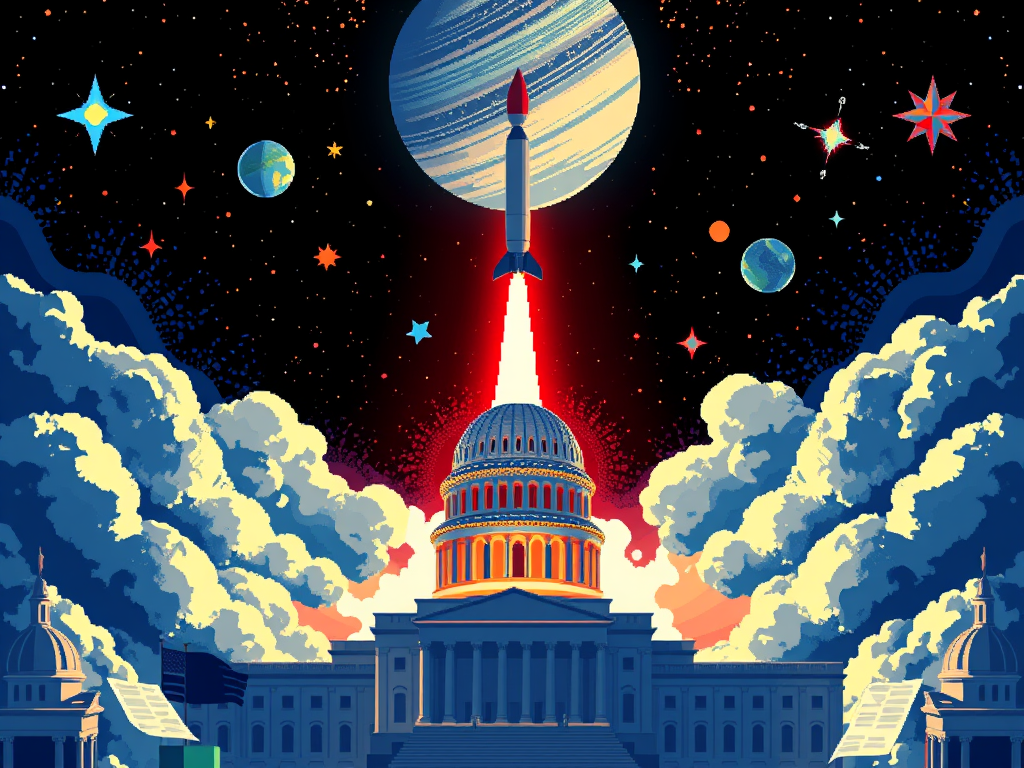
Over the five years that the US Space Force (USSF) has existed, it has made significant headway standing up an entirely new service as well as efforts to normalize its operations and find its place in the joint force. What has also become clear over the past five years is what founding myths the Space Force and its supporters have created including the circumstances and politics surrounding its 2019 establishment.
While efforts to consider and legislate for a space force had rambled about on Capitol Hill for several years, it was Donald Trump’s support for an independent space force during his first administration in 2018 that set the wheels in motion for the service’s creation. Despite the president’s support, there was still significant opposition to it both inside the Department of Defense (DOD) and Congress. While planning efforts continued throughout 2019 as negotiations over the National Defense Authorization Act (NDAA) wore on, most insiders did not expect the legislation to include the Space Force. Those circumstances changed almost overnight when Democrats and Republicans struck a deal: the Space Force for 12 weeks of paid family leave for federal employees.
Unfortunately, the narratives about the USSF that have since developed do not include these political circumstances but rather center on the strategic need for an independent space service. Here, I argue that leaving the politics out potentially means misreading and misunderstanding the breadth and depth of political support for the Space Force in Washington. This is particularly important as the DOD and Congress will have to make hard budgetary choices in the coming years.
To be sure, the argument presented here—that the Space Force and its backers are all but ignoring the political circumstances surrounding their founding to their detriment—is not meant as a knock against the USSF or its Guardians. Rather, it is meant in the spirit of wanting them to succeed and encouraging them to see the totality of events rather than a partial slice to do so.
The Trade
The details of the family leave for USSF trade are important and worth recounting in brief. The negotiations over the fiscal year 2020 NDAA were some “of the most contentious—and partisan—defense negotiations in recent memory.” Among the priorities of the first Trump administration was the creation of the Space Force, an idea that Trump endorsed in 2018 and later directed the DOD to begin planning for. Despite the president’s support, congressional Republicans did not see it as a top priority with the Senate largely opposed. Even then, there were disagreements between the House and the Senate over how the Space Force should be structured.
Contributing to the ultimate breakthrough in negotiations was another Trump administration priority, specifically one championed by Ivanka Trump: paid family leave. Further, Jared Kushner, the president’s son-in-law, contributed to the final negotiations. The New York Times reported that it was “Mr. Kushner who helped broker a deal to create the Space Force, a chief priority of the president’s, in exchange for the paid parental leave, a measure championed by his wife, Ivanka Trump, also a senior adviser to the president.” Despite the appearance that the Trump administration got a double win, parental leave was also a major priority for Democrats. Then House speaker Nancy Pelosi “encouraged” leaders of the House Armed Services Committee to trade parental leave for the Space Force.
While the Trump administration ultimately got what it wanted in establishing the USSF, it was unlikely to come about when it did without this explicit trade of policy priorities. The Washington Post reported that “Congressional Republicans were less determined to get the Space Force approved than the White House because it hadn’t been a GOP priority before Trump took office. They were undercut by the Trump administration, as the president had told advisers he wanted to be able to trumpet the creation of the Space Force as part of his reelection bid.”
Emerging Narratives
In the five years since, this political trade has been largely downplayed by the USSF and its supporters. Of the search results for “origins of the Space Force” on Google, none of the results on the first page mention the family leave trade. Three book length accounts of the origins and establishment of the USSF (Standing Up Space Force, The United States Space Force, and The United States Space Force and the Future of American Space Policy) do not include anything discussing the trade for family leave. The Wikipedia entry for the Space Force also contains no details on the negotiations leading up to the NDAA. Taking it one step further, the source cited in Wikipedia’s discussion of the Space Force’s birth, a DOD history of the origin of the Space Force, doesn’t even talk about it. This is particularly interesting as the report contains an extensive play-by-play of NDAA negotiations throughout 2019. The lone exception (to my knowledge) is a chapter on the USSF’s first chief of space operations in a new collection of biographies of early space leaders.
What these sources do discuss is the strategic necessity of an independent space force. For instance, a 2024 “Space Force 101” summary highlights the ways in which our modern way of life, economy, and military depend on space with those interests “at greater risk than ever before.” The USSF’s own history reports that “The establishment of the USSF resulted from widespread recognition that Space was a national security imperative. When combined with the growing threat posed by near-peer competitors in space, it became clear there was a need for a military service focused solely on pursuing space superiority in the space domain.”
Why is there such a difference between the facts on the ground and the narratives that are being told? Why is the reality being, at best downplayed, and at worst purposefully ignored? While I do not believe that there are any bad intentions on the part of those writing these histories, there are several plausible reasons for ignoring the family leave trade. First, there might be fear that support for the Space Force, either congressional or public, would be undercut by recognizing the political reality. Because establishment of the Space Force was championed by Trump in his first administration, there is already an element of politics surrounding the organization given the polarized views of President Trump.
Second, Space Force supporters could see themselves as continuing to make the case for the strategic necessity of the service. This can be seen as particularly important given the low levels of awareness about space issues and indecisive support for the service more generally. By centering the Space Force’s history on the importance of protecting and defending American interests in space, the service and its supporters continue to make the argument to the public as to the necessity of the USSF.
Finally, and relatedly, Space Force supporters may feel as if recognizing the explicitly political origins of the USSF takes something away from the service and the need for it. While they may not be doing this purposefully, the seemingly systematic downplaying seems to suggest an insecurity about the Space Force’s origins. In other words, in recognizing the politics around the USSF, it questions the very need for the service in the first place. Several pieces written in the years since 2019 have highlighted the need for the Space Force to focus on results and communicate their value to the public demonstrating a continuing sensitivity to the service’s reasons for being.
Regardless of why this stark divide has developed, the divergence between the reality of the Space Force’s establishment and the stories being told about it is real. What’s more, it suggests a real insecurity stemming from partisan politics, strategic realities, and a lack of public support. While USSF leaders are unlikely to downplay the importance of their service, at the very least, they should understand the politics and level of support when headed to Capitol Hill. As such, remembering the political circumstances are nonetheless important to remember.
The Importance of Remembering
Again, I am by no means suggesting here that the Space Force was not necessary. Recognizing that the Space Force came about because of a very political negotiation and trade is not a hit against the institution. It does not take anything away from who they are or the kind of organization that is being built. However, to obscure this reality is to potentially overstate the depth of political support for the USSF as opposed to the operational and strategic need.
The narratives described above essentially argue that there was a great deal of political support for the USSF following from a recognition that the strategic reality of modern warfare requires a more active posture on the US’s part in space. Indeed, an Aerospace Center report on the USSF’s history says that Trump’s 2019 proposal for an independent space service “enjoyed bipartisan support and led to Congress passing the proposal as part of the FY 2020 NDAA.” The problem with this narrative, however, is that it grossly overstates the political support for the USSF at its founding. Further, these narratives suggest that there was widespread agreement as to the need for a space force at that particular moment in time and it was this need that led to the USSF.
The reality is that the Space Force’s founding was far more contingent. Recognizing this means recognizing that there was in fact no widespread agreement that the Space Force was necessary at that moment in time. If there was, there would not have been a need to trade one policy for another; instead, members of Congress simply would have voted for the service without a family leave policy—or any other trade—included in the NDAA. Further, while Democrats could be expected to oppose a Trump initiative, media reports such as those noted previously, all show that Republicans were at best disinterested without Trump’s insistence.
Remembering this is important because believing that the Space Force has widespread support on Capitol Hill may lead the Space Force and its supporters to misread today’s politics. While the Space Force’s budget has certainly grown in its five years of operation, it is not currently being funded at the levels that it would like to see. DOD and Space Force leaders are increasingly ringing the alarm bells as to funding challenges in the coming years. But the Congress does not seem to be hearing those alarms. Both the House and Senate appropriations committees have actually proposed cutting approximately $1 billion from the Space Force’s budget in fiscal year 2025. Understanding that the political support for the USSF is not as wide or deep as the strategic necessity narratives would have us believe is key to understanding this disconnect.
Two things can be true at the same time. The USSF can be both strategically necessary and born out of politics. Recognizing both does not take anything away from the service or its Guardians. But ignoring one element does allow for a misreading of political support for the service and a miscalibration of the political approach the Space Force should take with respect to Capitol Hill. While there is no chance of the Space Force going away, particularly after the recent presidential election, it can still win and lose the budgetary game. Just as it is important to see the strategic reality facing the United States around the world, it is important for the DOD and the USSF to recognize the political reality they face at home. Only by doing so can they create strategies that win them the support and funding that they will need in the years ahead.
Dr. Whitman Cobb is a professor of Strategy and Security Studies at the US Air Force’s School of Advanced AIr and Space Studies (SAASS).
Disclaimer: The views expressed are those of the author and do not necessarily reflect the official policy or position of the Department of the Air Force or the U.S. Government.





Leave a Reply