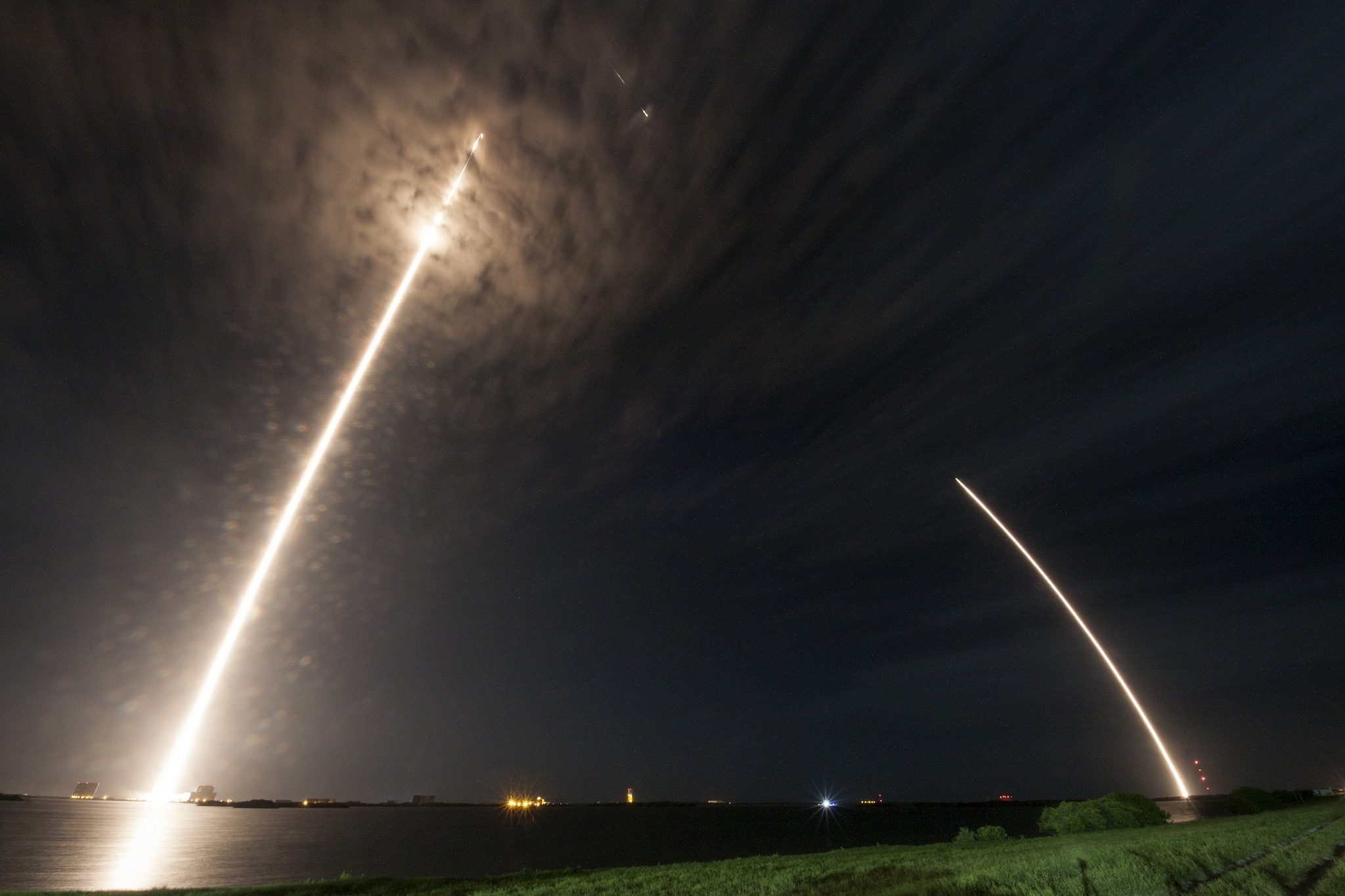
How China projects Hypersonic Capabilities into Space
By Roman C. Lau
Estimated Read Time: 9 minutes
On July 27, 2021, China launched a long-range missile that went once around the world and released a hypersonic glide vehicle that finally impacted close to a target back in China. General John Hyten, then vice chairman of the Joint Chiefs of Staff and the No. 2 person in the U.S. military, believed that the Chinese could one day have the capability to launch a surprise nuclear attack on the U.S. Asked if he would compare the Chinese test to the 1957 Sputnik shock, Hyten replied that “Sputnik created a sense of urgency in the United States. . . [and that] the July 27 test … probably should create a sense of urgency.”[1] This article takes a closer look at what the Chinese test was all about and why the exposed capabilities not only affect missile defense issues but, in the medium and long term, will also affect time, space, and forces in the military theatre.
The Chinese July 2021 incident
It was one of the most spectacular circumnavigations of the last decades. In July 2021, a Chinese Hypersonic Glide Vehicle (HGV) launched on top of a rocket, flew around the globe, and landed back in China. However, none of the distinct parameters of this flight on its own was revolutionary or spectacular. On the one hand, the ascent of the Hypersonic Glide Vehicle (HGV) was not too much different from a standard rocket launch into a Low Earth Orbit (LEO), and reaching an orbit from the surface of the Earth with a rocket has been part of everyday business for decades. On the other hand, the gliding vehicle’s re-entry into the atmosphere and gliding to the ground have also been well-known space travel procedures, the latest since the U.S. Space Shuttle program. However, it is worthwhile to consider how and why the Chinese 2021 orbit is so significant and reminds some of the “Sputnik shock.”
Reliable information about space and military missions is regularly subject to high-level confidentiality. Therefore, the Chinese glider’s mission profile in this analysis can only be a sketch without claiming to be true to detail. At the very least, this sketch represents a model demonstrating possible developments in hypersonic technology. However, a Long March 2C rocket might have launched from Taiyuan Space Launch Center on July 27, 2021. This rocket ascended northwesterly, passing Central Asia, the Middle East, and Africa. The altitude and speed achieved were high enough to exceed the usual ranges of a Long Range Missile or even an Intercontinental Ballistic Missile (ICBM).
Conversely, the altitude and speed achieved were low enough to ensure re-entry into the atmosphere before the end of the intended single orbit. After crossing the Equator southeast bound, the vehicle passed South America and the Pacific and finally returned to Chinese territory from the east. When reentering the atmosphere and descending through the altitude band of 80-40 km, the vehicle started using its aerodynamic maneuverability and turned towards a return zone in Qinghai province. Finally, it seemed to have missed the intended target by some kilometers.
The peculiarity of this profile is not the Chinese ability to launch a spacecraft into orbit and then perform a controlled re-entry to land on the ground. China had already provided this proof on September 6, 2020, when an experimental reusable spacecraft completed a two-day flight in LEO.[1] That spacecraft had taken off the Jiuquan launch base in the Gobi Desert on top of a Long March 2F rocket and ascended to an orbital altitude ranging between 332 and 348 kilometers. With this transport mission profile, comparable to NASA’s Space Shuttle or Boeing X-37 profiles, the 2020 space vehicle test demonstrated the attributes of a reusable transport device.
In contrast, the July 2021 profile appeared more like a deliberate one-time use. First, the Long March 2C is not an efficient candidate to shoulder a re-entry vehicle (RV) able to bear the actual payload. IN THIS CONFIGURATION, the RV would consume too much of the 2C’s limited cargo capacity and leave too little for the actual payload. Second, the trajectory’s westerly direction, against the Earth’s rotation, consumes a significant amount of the rocket’s energy. With the 2C’s rocket power, such a trajectory makes less sense for a transport mission into space, aiming for a stable orbit and more reason to reenter the atmosphere soon. Third, the rocket’s altitude, range, and velocity configuration, combined with its payload, suggests the intention of a point-to-point delivery with global coverage. In a 2022 report, the DoD summarized the July 2021 profile as the “greatest distance flown and longest flight time of any PRC land attack weapons system to date.”[2]
To reach any target on the globe from any launch site, an ICBM’s range, speed, and energy need only to overcome half of the circumference of the Earth, in most cases less. The Chinese test vehicle exceeded an ICBM’s typical and necessary ranges. In other words, the vehicle closely completed a full earth orbit, reentered the lower atmosphere, and maneuvered with hypersonic speed toward its target, introducing the mission profile of a hypersonic weapon engagement beyond global reach. The Long March 2C enabled the test vehicle to overcome global distance quickly, transitioning through airspace and near space, maneuvering aerodynamically with hypersonic speeds, and aiming for a specific target. The object’s trajectory with a single westerly orbit signaled solid energetic reserves for a permanent orbit in case of a launch in an easterly direction. Therefore, that Hypersonic Glide Vehicle became the world’s first prominent Hypersonic Orbiter.
The Hypersonic Orbiter
Military planners consider three main operational factors in the military theatre—time, space, and forces. The Hypersonic Orbiter’s striving trajectory demonstrated the capabilities for traveling faster, overcoming global distances, and being less predictable about the intended target. Related to the three operational factors, the Hypersonic Orbiter underlines three claims.
First, the Orbiter addresses the operational factor time. From an orbital speed of about seven km/s, the glide vehicle started re-entry and reached the target area within a few minutes. Such a re-entry profile corresponds to decades of practice of the U.S. Space Shuttle. Nevertheless, the Space Shuttle gradually reduced speed during descent to the lower subsonic range to land horizontally on a runway—the Space Shuttle was designed for re-use.
On the contrary, the Chinese built the HGV to hit the target as a weapon as fast as possible within the utmost physical limits. It is technically conceivable to engineer a vehicle for a decent phase of 800-1,200 seconds out of an orbit altitude of 130 kilometers with an end-game speed of Mach 6-12 (2-4 km/s; 4,500-9,000 mph) until the impact (see figure 1).[3] The HGV technology could seamlessly link near space, airspace, and the Earth’s surface as a new capability. Such a space-based HGV would be a lurking asset, launchable without a booster’s plume, surprising and overcoming defenses, and reaching for the Earth’s surface in 15-20 minutes. Hence, China’s July 2021 test flight points to the possible shrinking of reaction times and the challenge of existing missile defenses’ decision chains.

Therefore, pre-stationing a Hypersonic Orbiter in space is conceivable and can be seductive for any competitor. With the help of a support module or small control nozzles, that Orbiter could smoothly and covertly maneuver from a long-term stable orbit above 400 kilometers altitude down to 130 kilometers altitude. From there, it could turn into a steeper dive and reach objects on the Earth’s surface with pinpoint accuracy within 15 minutes—without an observable classical booster phase. In particular, the lack of ascent of a carrier rocket and the absence of the usual IR signature would significantly reduce warning times, and a shortened warning time would substantially affect the operational factor time.
Second, the Orbiter addresses the operational factor of space because, likewise, for any HGV, it uses both the higher altitudes of airspace and the realm of near space. Therefore, the Orbiter questions the perceived boundaries between the two domains of airspace and space. There is the airspace domain with aerodynamic flight on one side; on the other, there is the space domain with the orbital physics of gravity. As an alternative domain approach, the author recommended the hypersonic airspace concept as an operational framework to better describe the impact of hypersonic weapons in the air and space domain and the ramifications for military operations. Although the Chinese vehicle appeared as an orbiting space object, it proved to be a maneuvering HGV in airspace and, therefore, has emphasized the dissolving of previous borders between airspace and space—it claimed the entire endeavor of hypersonic airspace.
Third, the Hypersonic Orbiter integrated orbital altitudes into the flight profile, demonstrated the development and measurable deployment of maneuverable weapons further toward space, and, therefore, shifted the employment of operational military force. An ICBM could strike any global target from a home base within less than an hour from launch to impact. That is the claim of the Conventional Prompt Global Strike (CPGS) program.[4] The Hypersonic Orbiter could strike within less than half an hour without a plume. Space-based hypersonics could potentially change the conduct of war at the operational level and influence the understanding of strategic deterrence by shifting more operational military force toward the space domain. When competitors or adversaries start enhancing and leveraging hypersonic possibilities toward near space and leverage this force, the U.S. and its Allies need to adapt. They would have to upgrade surveillance and reconnaissance in the space domain, re-think high-value asset protection, and thoroughly reorganize operational forces and capabilities.
To summarize, the concept of a Hypersonic Orbiter will unleash its full operational and strategic potential when deployed from a permanent orbit. This weapon must be stationed in space to fully impact all three military operational factors. Therefore, the July 2021 Chinese test matters because the Hypersonic Orbiter’s attributes, probably even more effective with pre-stationing in space, could significantly change the conduct of war. This lurking capability demands a sense of urgency to cope with an unfolding weaponization of space. The author will further address this matter in a subsequent article.
Roman C. Lau is a Colonel in the German Air Force and former air force faculty chair of the Führungsakademie der Bundeswehr in Hamburg, Germany. He is a graduate of Universität der Bundeswehr, Hamburg; Joint Advanced Warfighting School, Norfolk; and a scholar of National Defense University, Washington, DC. Essential parts of this article are based on the content of Colonel Lau’s master’s thesis at the Joint Forces Staff College.
Disclaimer: The views expressed are those of the author and do not necessarily reflect the official policy or position of the Department of the Air Force or the U.S. Government.
[1] CBS, “CBS Exclusive: No. 2 in U.S. Military Reveals New Details about China’s Hypersonic Weapons Test,” CBS News, September 16, 2021, https://www.cbsnews.com/news/china-hypersonic-weapons-test-details-united-states-military/.
[1] Stephen Clark, “China Tests Experimental Reusable Spacecraft Shrouded in Mystery – Spaceflight Now,” accessed February 16, 2022, https://spaceflightnow.com/2020/09/08/china-completes-test-flight-of-experimental-reusable-spacecraft/.
[2] “Military and Security Developments Involving the People’s Republic of China – Annual Report to Congress” (Office of the Secretary of Defense, 2022), 94, https://www.defense.gov/CMPR/.
[3] “Hypersonic Impacts: Operational Impacts of Hypersonic Weapons and the Change of America’s Strategic Situation,” 70, accessed February 13, 2023, https://apps.dtic.mil/sti/citations/AD1160437.
[4] “Hypersonic Impacts,” 38.




Leave a Reply