By Peter Garretson
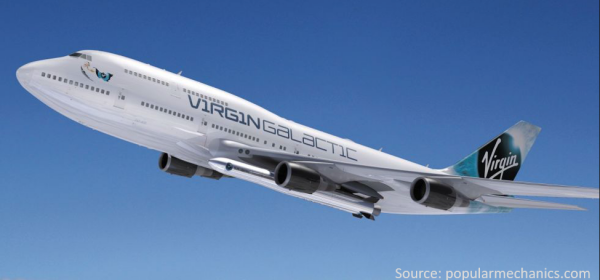
Virgin Galactic has done something very clever. For about $4M, they have modified a Boeing 747 to be able to travel as far as 1,000 nm and then launch a small satellite into orbit. This is going to provide industry—and potentially the Air Force—with a responsive launch-on-demand capability it has never had.
The USAF also maintains something called a Civil Reserve Air Fleet (CRAF). These aircraft are typically provided by civilian airlines who contract with the US military to be available for mobilization in a time of need. Often, they are paid a premium to keep certain equipment–such as hardened floors that can carry special military payloads even though it adds weight.
Within the CRAF, there are several 747s. Modifying some of those 747s would provide the USAF an unprecedented flexible, responsive space launch capability. Based on Virgin Galactic’s demonstration with Cosmic Girl, the USAF could modify up to 25 aircraft for $100M, or the cost of one F-35. A fleet of 25 aircraft flying around the world providing a flexible space launch capability would also impose significant costs on any adversary looking to degrade or deny US access to space. Twenty-five aircraft that could launch satellites into orbit 1-2 times per day would provide both a significant replenishment capability and a significant theater augmentation capability.
Furthermore, a station capable of holding and launching an orbital-class rocket with a small-sat payload could also support an intercontinental-range, conventional prompt global strike. Such an asset could hold a very long-range Air-to-Air Anti-High Value Airborne Asset missile, a counter-ship missile, or a SEAD/DEAD capability to establish a standoff strike range advantage in an A2AD or Air Sea Battle Environment.
Such a station could also easily host external pods that are far larger than existing platforms can carry. These pods could hold very large RF devices such as radars, jammers, large aperture collectors, transmitters or gateways. New capabilities could be added without significant need for modification and qualification, and it would be relatively easy to trade out such pods.
For a mere $100M, the USAF could gain new resilience, a new attack vector, a significant amount of freedom of action, and impose significant costs on those attempting to counter a novel and currently unchecked capability.
Lt Col Peter Garretson is an Instructor of Joint Warfare at Air University’s Air Command and Staff College (ACSC), and lead for the Air University Space Horizons Research Group, which seeks to “Re-imagine Spacepower in the Age of Asteroid Mining.” Lt Col Garretson has over 50 publications covering space topics, strategic culture, and US military strategy and security cooperation in Asia.
Disclaimer: The views expressed are those of the author and do not necessarily reflect the official policy or position of the Department of Defense or the U.S. Government.





Leave a Reply